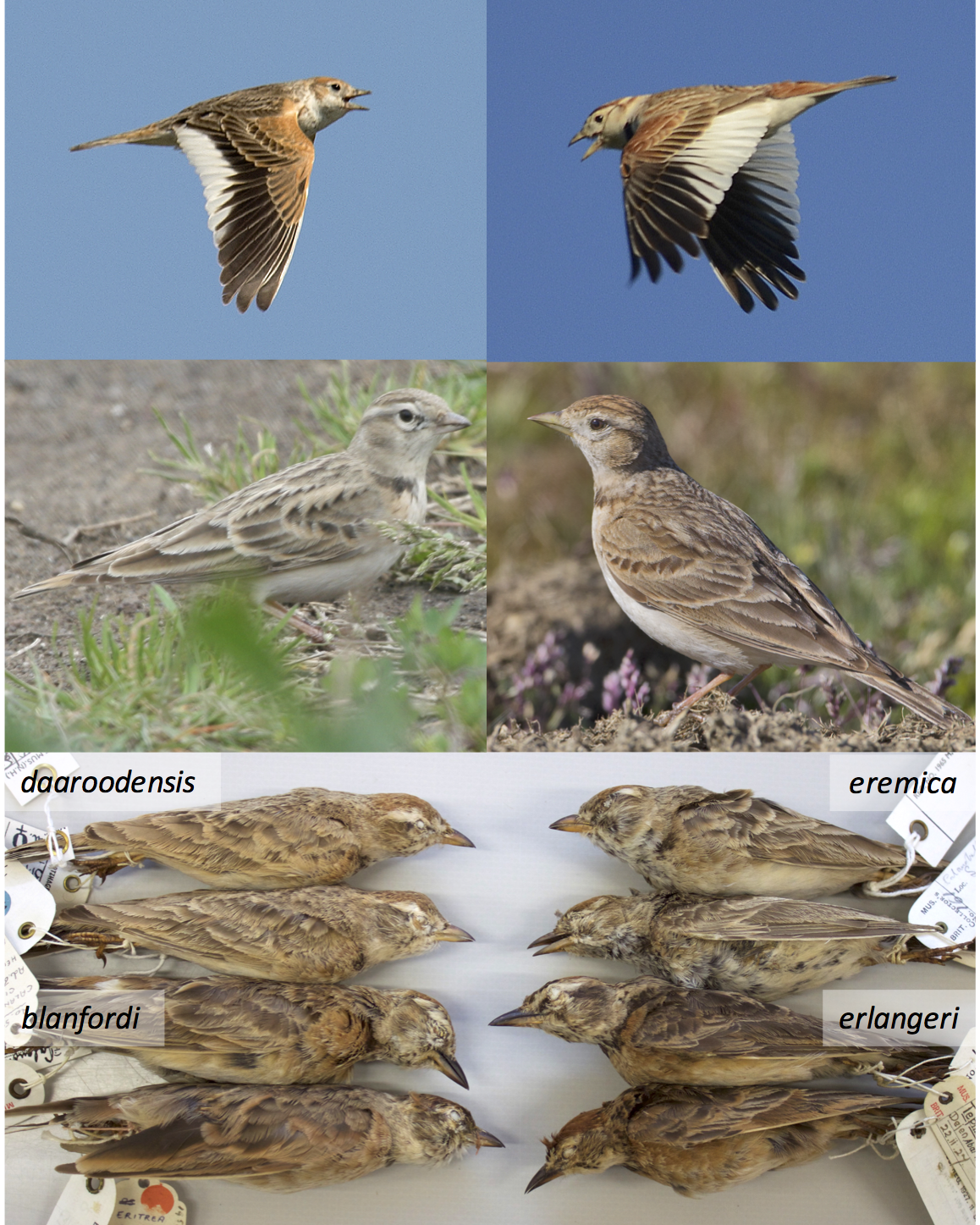
Figure 1 (from Stervander 2015). Larks (family Alaudidae) display strong adaptations in bill morphology and plumage, and recent studies have revealed both convergent evolution and cryptic taxa. Alström et al. (2013) demonstrated an extreme case of convergent evolution in the White-winged Lark Alauda leucoptera (top left) and the Mongolian Lark Melanocorypha mongolica (top right), previously thought to be congeneric. We confirmed that Calandrella [brachydactyla] dukhunensis (middle left) is a separate species from the Greater Short-toed Lark C. brachydactyla (middle right), more closely related to Hume’s Short-toed Lark C. acutirostris, though it morphologically resembles the Greater Short-toed lark. We also show that C. blanfordi daaroodensis and C. b. eremica form a clade that split over four million years ago from C. b. blanfordi and C. erlangeri, which are recently split sister taxa (bottom). Photos, with permission for use in Stervander (2015): Kari Eischer (top left), David Thorns (top right), Matt Poll (middle left), Juan Lacruz (middle right), Martin Stervander with permission from the British Museum of Natural History (bottom).